


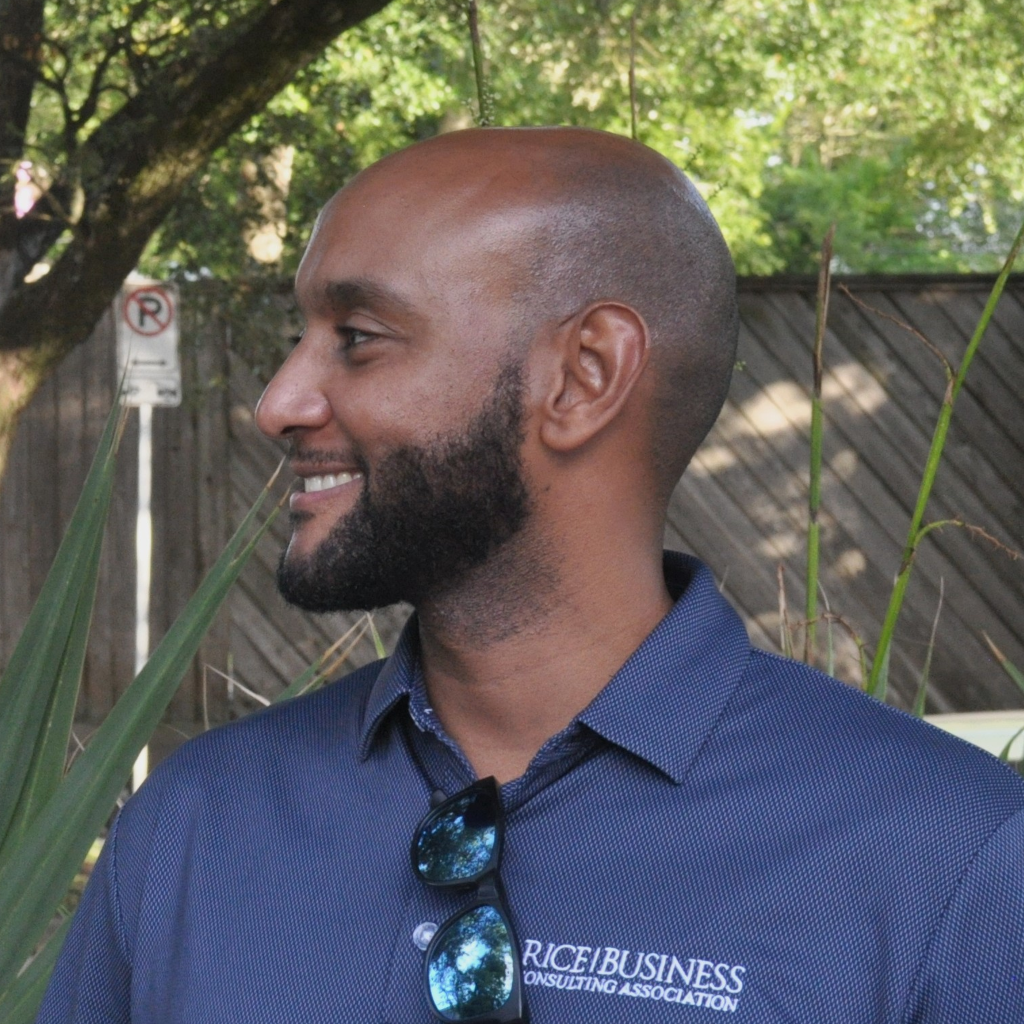
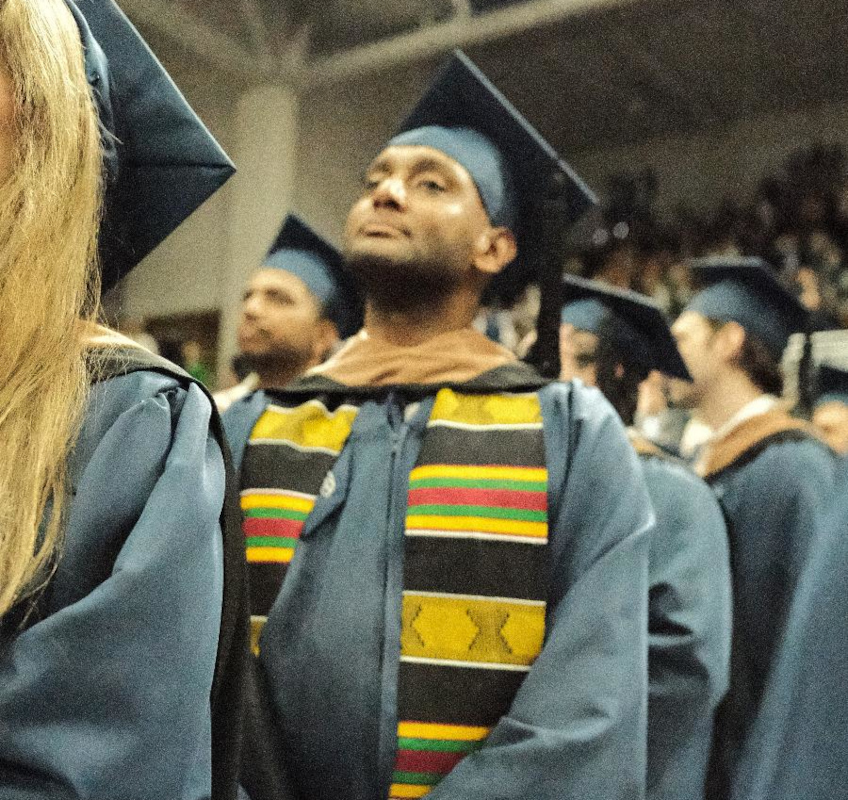
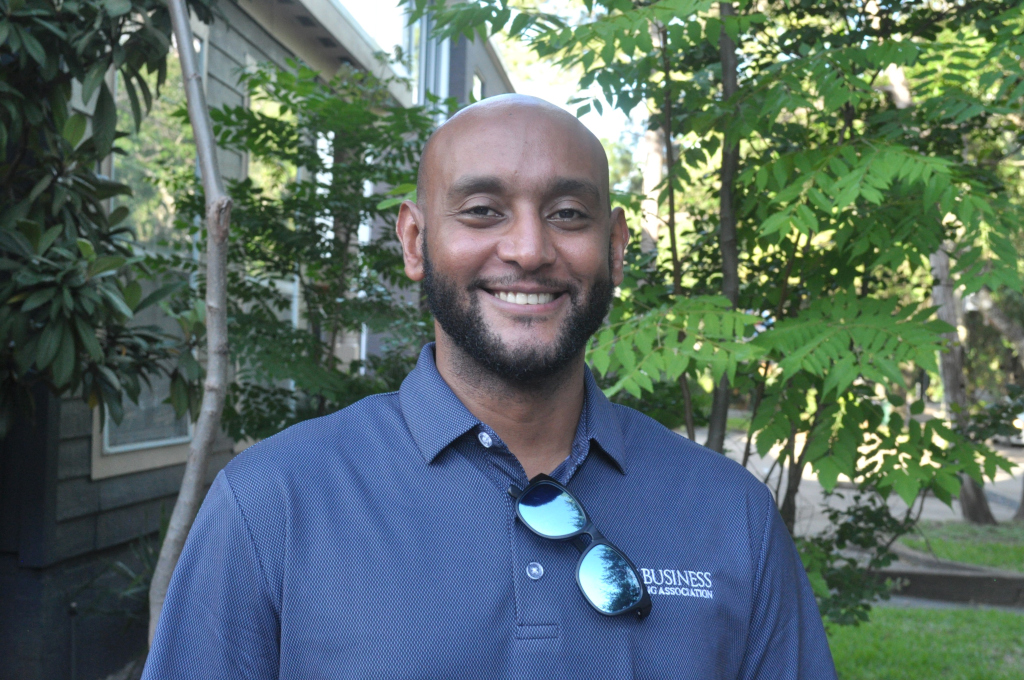
It’s graduation day. Much like the MBA candidates, Tudor Fieldhouse at Rice University dressed up for the occasion; the hardwood full of meticulously placed chairs, the arena seats populated with family members, and temporary stage set for the graduates to walk across. Nebiyu Barsula squeezes his way through the crowded floors careful to not invade anyone’s personal space, flashing a smile to his classmates, and embracing his closer friends. His Rice Blue graduation gown was donned with the colors of his home country of Ethiopia. Barsula shuffled his way towards his seat and placed himself between two classmates, the same two classmates he sat between during launch, the name of the two week orientation for the Rice MBA program.
As he settled himself, Barsula scouted the arena to locate his family. In attendance was his brother, sister-in-law, his two nieces, his uncle, and his mother who traveled from Ethiopia. “Before you know it, your name is called, and then you’re just like, let me make sure I’m walking correctly. I hope the lady says my name right, and then it’s like, you just make a loop, takes less than a minute, and then you’re back sitting down. It’s like, just like, graduated,” Barsula said.
What felt like an insurmountable, long, and daunting task at launch fast forwarded to a rewarding four semesters and consummated into an unforgettable surreal feeling on graduation day. “It’s a little bittersweet; I think the MBA came and went really fast. It’s only a two-year program, that’s really four semesters, not even two full years, and you become completely focused on it while you’re in school, so you don’t get to focus much on the rest of your life, which in a way is good, because you form very close bonds with the people that are there, but the moment it ends there’s a withdrawal period, and if you’re like me and you like people, the end came too fast, and then all of a sudden everything was quiet. So, after our last day of class, we had two weeks of our graduation, and I remember those two weeks.”
In just a few months time, Barsula would begin his new role as a consultant at Deloitte. All of his life decisions thus far accumulated to this point; the decision to make the career change from engineering and into consulting.
Nebiyu Barsula’s legal and professional name is Nebiyu Sermollo. “In this country, I introduce myself as Nebuyu Sermollo, only because that’s how my legal name is structured, but back home, I’m Nebiyu Barsula, nobody really knows the Sermollo name, and we don’t have family names there. It’s always first name, father’s first name.” The name Nebiyu comes from biblical origins, Barsula’s grandmother would bestow him the name Nebiyu, which means the prophet in Amharic.
In typical fashion of his personality – ultra focused and present minded – Barsula spent the morning theorizing and discussing the intricate plot points of Digimon Zero Two with his fellow classmates. The boy version of Barsula spent six years at the international school of Greek Community School which offered Greek and British curricula, opposed to the local Ethiopian schools. “When I went to school, they accepted both international and domestic students equally, so I was about a 50/50 split. It’d be like usually the kids of ambassadors, or like diplomats in the country, or businessmen who are living in the country, their kids, but that shaped a lot of my exposure early on to a lot of different types of humans. It also helped me learn everything in English, which is not how the curriculum in Ethiopia is set up,” Barsula said.
Ethiopian examinations occurred every two years starting at eight grade. “the one that you had to take at the end of 12th grade was the university entrance examination” which opened pathways to studying at the best schools in Ethiopia or in schools aboard. With this in mind, it developed as a motivating factor for Barsula’s parents to moving him and his brother from the international school to a private school. It came at the sole discretion of his parents and a decision with Barsula having no agency.
The rainy season in Addis Ababa faded to its conclusion and transitioned to the ever familiar Ethiopian dry season. However, this September day perfectly blended between the two seasons, the sun not overpowering, and the humidity washed away. Barsula sat down at this desk for this first day of 11th grade at the prestigious Catholic St. Joseph High School. He made note of some desk carvings made by the students of previous years. Desk and seat legs appeared secured, no wobbling. Barsula, the first student to arrived, looked at each student who came through the door one by one, anxious to see a familiar face. It was also the first time Barsula was without his older brother of two years and one day – who left Ethiopia to study electrical engineering at the University of Houston in the United States.
Upon entering the final two years of school, Ethiopian students would reach their first fork in life, “Once you finish 10th grade, you have to choose one of two paths: one is called the arts and one is called the sciences. If you choose the sciences, you would take courses in, like, of course, math, English, and computer science, but you would take biology, chemistry, physics, something called technical drawing, so the two groups would diverge at that point, and you’re basically prepping yourself to enter either engineering or more of the hard sciences.” Sixteen year old Ethiopians were given this responsibility of this decision, with weight the of the 10th grade exams hanging on their shoulders, “I believe your score also helps determine this to some extent, but you have to score above a certain point if you’re going to stay in the higher education path. For students who don’t pass at the 10th grade exam level, they usually enter into like trade schools and become like master technicians, electricians, HVAC folks, things like that, mechanics, and so there’s already some sort of pressure there.” Barsula said.
This amounted to the second decision in Barsula’s life, but the first one where a level of autonomy presented itself. Barsula mentioned at the time he did not value the subjects featured in the arts as he does now, “I knew that I enjoyed being in math class, physics class, and chemistry class the most, that was about it. I did have a conversation with my dad, but I remember him being like, it’s obvious, like, you love these classes, really good at them. Most opportunities in the future, most valuable opportunities will come in the sciences. You should pick the sciences, and I was like, you’re right.” Barsula said, the choice came more or less naturally without much commotion.
After completing secondary school in Ethiopia, Barsula would follow his older brother Zerayacob to the University of Houston with declaring mechanical engineering as his major – what he considered his first major decision. “I read through what it means to be a mechanical engineer, electrical engineer, chemical engineer, electrical, because my brother had already a year ahead of me, he was already in the US at that time, a year in, and so he picked electrical, and I was like, not picking what he picked.” Barsula said. His exceptional skill in technical drawings and sciences tipped the decision to mechanical engineering. “Mechanical engineering became obvious for me, and it also felt like the most versatile degree, like it could be easily turned into other, easily move into other disciplines in engineering, if you wanted to.” The versatility of mechanical engineering won him over. “the other critical decision was coming to the US, which wasn’t really my own decision. We also had my mom’s older brothers already in the US, they had come here years ago, and so that was the reason why my brother came to Houston first, and so it was a almost a foregone conclusion that I would also follow him, and when I thought about it, I wanted to as well.”
Anyone could have waved their hands through the air and collect the dense humidity Houston had to offer. Barsula’s older brother drove themselves to the University of Houston campus, plodding his car carefully down each row of parking spots. As per morning tradition, each spot filled with a vehicle just more inspired to reach the parking lot than the next; the relief of finding a spot only to be replaced with the frustration of an adjacent parked car that stood a tire’s width over the weathered painted line made for a questionable fit become a familiar feeling. Barsula and his brother would make the long daily trek from leaving the overfilled parking lot to the safety of the air conditioned fortress known as the Cullen College of Engineering Building 2. The older Barsula would quickly deviate from the pair, and the younger Barsula, still recovering from the Houston humidity, wandered to his research lab.
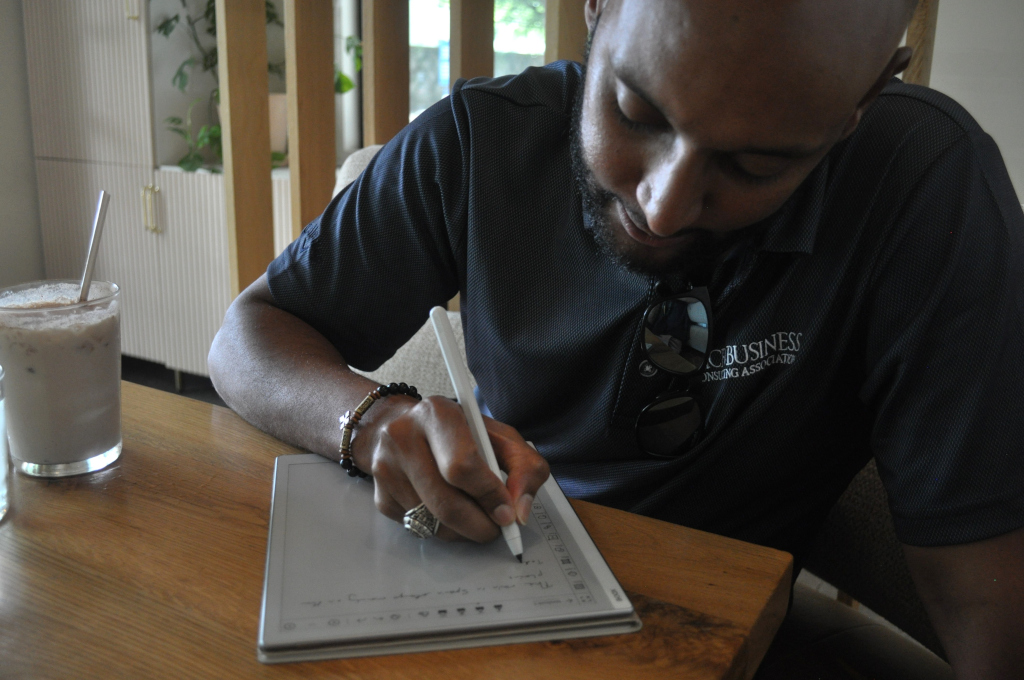
Towards the end of Barsula’s time in undergraduate studies, he explored options for after completing his degree. “The summer before senior year, I started to take the GRE, and concurrently kept applying for jobs, unsure of which one was going to pan out, and I got accepted at UT Austin,” Barsula said. The research experience Barsula gathered at the University of Houston became one of the variables for his decision to pursue the PhD program at UT Austin. “I had fortunately already accumulated a little bit of research experience and could speak to some of the topics that the different professors were researching, so that was very beneficial in the acceptance.”
Not before escaping Houston for Austin, Barsula weighed his options with continuing education and being employed full time in the industry. “My first major independent decision was going to grad school versus working, and there was significant pressure from my family to not go to grad school right away, because to their credit and their experience, they were like graduate school is something that you want to go to after you know what you want to study and know what you want to pursue, the and they were eventually would be proven right. I thought I wanted to get a PhD in engineering and engineering mechanics.” Barsula’s decision didn’t come without some level of struggle. “Yeah, it wasn’t easy, but compared to how I approach major life decisions. Now it was made with a little bit of eagerness, and probably not understanding what graduate school entailed, and what working life entailed.”
It wasn’t easy. Barsula knew that much, but not to the extent he experienced, but he was always an exceptional student. As Barsula completed his first semester and entered the winter break, the massive unmalleable slab of concrete that grew pound by pound on his shoulders began to melt away. That second of relief he felt – feeling like he could finally breathe – was replaced just as quickly with an even bigger slab. “Oh my god, these courses are so hard. That is the kind of consideration I did not make. I didn’t think about all the what it means day to day, what classes I’d be taking. A practical thing to do is like what courses do I have to take in graduate school. I no idea what I was getting myself into,” Barsula said. “At the end of the first year, I was very humbled at how hard all the courses were, and I did not excel except in solid mechanics, for in dynamics I struggled, and in math I was average. Very humbling, coming from mechanical engineering at UH, where I felt like math, I got this engineering I basically got it.”
Barsula paced around his white walled apartment, pencil in hand, his trusty Texas Instruments calculator in the other. He sat back down at his well worn desk, placed both hands on his face and gave away the longest sigh of the night. The sun expected to materialize in his line of sight in just couple hours, and the written qualifying exam would follow suit in an additional 48 hours. His text books opened to the pages that felt relevant for current subject matter, a few books at his desk, and the rest meticulously placed in any nearby flat surface. Not the same can be said for piles of paper and notebooks scattered where ever they could fit. Barsula never thought of this situation two years ago when he started his PhD program. “I asked my professor if I could just defer to the second year, and he said it’s like you had failed the first year because you’re just skipping this opportunity to take an exam when you could and practice, so if you don’t take it, you only get one more shot, and I was like, yeah, that’s what I want, and so I decided to take it at the end of the second year, and I failed.”
A few days after his exam, a humbled Barsula arrived at another decision point, and came to the conclusion of his graduate school experience would yield a Master of Science in Engineering with a thesis in Engineering Mechanics. “I stressed out a lot. I was the mindset that I was in then was if it’s not perfect, then can’t do. We’re all a little bit of perfectionists, but something that’s changed for me over the years. All to say, once I failed, and then the lead up to that exam, I realized that I was pursuing something for reasons that were not coming from my self,” Barsula said.
On the onset of completing his time at The University of Texas, Barsula’s time in his third and final year was spent completing his research and teaching undergraduate students. “I was made a supplemental instructor, so I realized that I was very, very good at teaching, won multiple accolades and got the highest rating from students for teaching,” Barsula said. At the odds of his research and teaching role fighting for the space that occupied his mind, Barsula grew to relish teaching his students, “So I got very good at teaching, and became more excited about that than the research I was doing. I enjoyed more the time I spent with people, not the time I spent sitting writing, like reading papers, getting out the data that I needed.” Barsula would move on and accept an engineering role in the semiconductor industry.
Three days have elapsed since Barsula left his Oakland area apartment. His bed comforter was immovable, his eye were stapled shut, and his limbs didn’t operate as if they didn’t belong to him. Barsula struggled out of bed, still a little early in the day, but 14 minutes later than when got up the previous day, and 36 minutes the day before that. Working from home was commonplace during Covid era, but it was something that didn’t mix for Barsula. “I had learned back home, back in grad school, how much I enjoyed working with others. So, when I was not getting any of that, I grew more and more dissatisfied.” Barsula said. The feeling of isolation dragged Barsula down a little closer to the floor each day. “I became depressed, became sad and depressed, and I felt as though I a little bit trapped in a way; I started to worry, like, is this what my life is gonna be like, and I felt a deeper kind of like alarm going off, where each day the idea of doing work felt less interesting than ever, because there was something deeper that was missing, which was social interaction. I wanted to be excited about what I did again.”
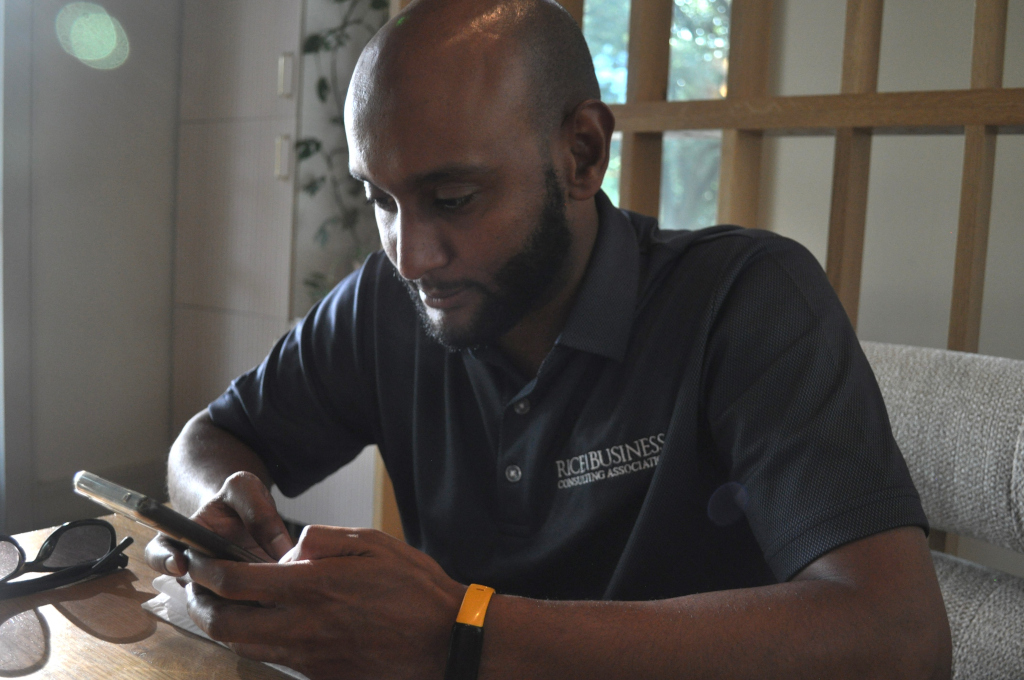
Barsula would work at the same job for close to six years with a third of the time spent working from home before coming to the decision to leave the company and return to his hometown for a year. Unlike his previous decision, this was different, there was no structured timeline, and the next steps were open ended. “This was the first time I made a decision to take care of myself and prioritize my own well-being with the time and money that I had, like accumulated time, I mean, like willingness to spend a year doing nothing is kind of an investment.” Every decision up to this point felt more difficult than the last. “Stand by the roads and look; and ask for the eternal paths, where the good, old way is; then walk in it, and you will find rest for your souls” – Jeremiah 6:16. “I found this quote hanging on a picture frame at my cousin’s house in Washington, DC. It helped me decide to walk away from my job” Barsula said. This would be one of the quotes Barsula lived by.
The return back home in Ethiopia was considered the best decision he ever made, but it would ultimately be part of the decision making process for the next thing in life. “The part that was scariest, and, like, how do I say this? If you’re asking a how question, there was the financial aspect. I needed to know if I could afford it, I had to define who I was without the money, and then I had to accept that even though I have an identity outside [of work],” Barsula said. “The hardest part was actually being okay investing all the money I had at that time on this type of gamble, because it’s just a gamble. You don’t know if you can find a job a year later. I don’t know what’s going to happen in Ethiopia. I have no health insurance, right? Like, it’s not wise. You’re like cutting yourself off from an excellent supply of income, and I was just like, yeah, I just want a break. It didn’t make a lot of sense to me. So glad I did that. I slept better than I ever had.”
Coming into another crossroad of life, Barsula navigated through his process to purse the MBA program at Rice University, it was a pivot away from engineering – from what his entire life was at this point. Among the MBA decision path, Barsula also considered the Air Force and a foreign services. While these other paths provided significant hurdles of their own, Barsula thought the MBA was the best choice for him. He credits his friend Carolina, who started her MBA program a year earlier, as a key supporter in his process. “She was one of the biggest champions and inspirations to pursue an MBA.”
The cascading decision making lead to the him coming out of the labyrinth to starting his MBA at Rice University. Just in the first semester was a non-stop whirlwind that came and went as chaotic as anyone could imagine. Students without experience in accounting and finance would enroll into pre-MBA courses. Only three weeks after the program begun, students were then subjected to the recruiting cycle, including networking and information sessions. From there it would get busier for Barsula, including an internship at the place he would be employed full time this fall of 2026. Where the career change from engineer to consultant would manifest itself.
The decision tree of life has made it’s current stop. Barsula could finally store his MBA text books, close out of the many spreadsheets, and be comfortable with his decisions. While Barsula believes there is no objective method of validating decisions, his thought train is just living with the decisions you make. “As I was making this decision, what are the factors that I was considering, and basically the objective that I was trying to get has that been met? If so, I guess we can call it validated, right? I didn’t want to feel isolated. I don’t feel isolated. I wanted to make sure I rested and didn’t feel sad and depressed each day.” Barsula said.
With the experience of decision making throughout his life, Barsula hopes other can be willing take more risks. “I found that in my experience there’s a lot more that stays the same than you think you will. I think life, the core parts of life, rarely change drastically.” Barsula said. “What I mean is, change is not as scary as we might think it is, and it’s worth if there’s out, if there’s an inkling that you have that a change is needed. I recommend people sit with that, get to the root of where that inkling is coming from, and not be afraid to try different things. You’ll feel like you can make more changes after you make one. It’s empowering.”
Recommendations from the subject: